
Why Brightness Changes Between Street-Light Poles
A route can have bright pools around its poles and poorly lit sections between them, even when every fitting is working. The pattern depends on the selected distribution, mounting geometry and the condition of the installation. Evaluate the complete route and its required lighting criteria before increasing output at each pole.
In this guide
Map the change along the route
Record whether the pattern repeats between every pole or occurs only at particular locations. Identify failed units, changed settings, dirty covers and unusual obstructions. Note the normal direction of travel and the point where visibility becomes difficult. A recurring geometric pattern suggests a different investigation from one isolated fault. Evaluate the route during the conditions that cause the complaint, since daylight, wet surfaces or a temporary full-output override can change how the problem appears to the observer.
Compare spacing with the actual optic
Pole spacing and distribution need to be assessed together. A replacement luminaire can change the useful overlap even if its wattage resembles the previous one. Obtain photometric information for the exact optical version and include mounting height, outreach and orientation in the project assessment. A beam label alone cannot establish the result on a particular road. Check the ends of the route and changes in width too, where a simple repeated spacing assumption may stop matching the area that needs useful light.
Ask about uniformity as well as averages
A high average result can hide poor minimum values between the bright areas. The project team should select the appropriate road or site lighting criteria and assess the relevant uniformity measures. The visual task may involve recognising an obstacle or another road user, rather than merely seeing a lit pavement. Avoid judging a completed route from a photograph with automatic exposure. Observations, a suitable lighting assessment and the actual geometry provide a more useful basis for discussing a change.
Check the installation remains consistent
Mixed lenses, power settings or tilts can interrupt an otherwise repeated layout. Compare model labels and the installed schedule, and have configuration differences checked by the responsible maintenance personnel. Include the cover condition and any nearby vegetation. If a pole has moved or a bracket has been replaced, confirm its geometry rather than assuming the original arrangement remains intact. Keeping those details consistent helps establish whether the remaining issue comes from the original layout or from changes that have accumulated during service.
Improve the cause before raising the load
Increasing output may brighten existing pools more strongly without providing the required improvement between them. Compare realistic options such as a different optical configuration, revised orientation or a changed mounting arrangement within the project’s constraints. Structural and electrical changes require their own assessment. Record the selected final arrangement and commissioning settings so future replacements can preserve the intended result. The objective is a route that meets its criteria consistently, rather than a collection of individually impressive bright sources.
A KIRITO option to discuss: ST71
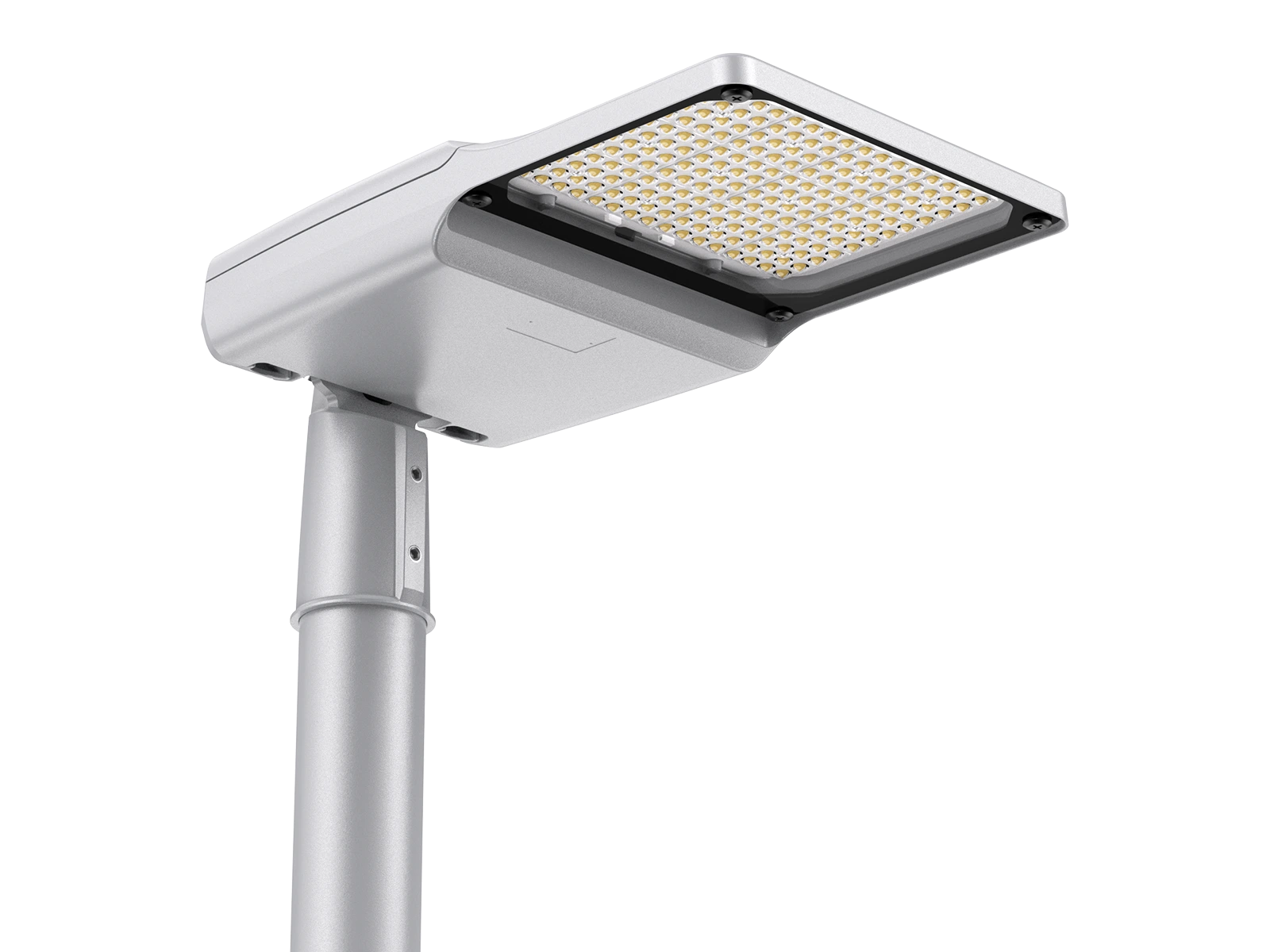
KIRITO ST71 is a relevant shortlist option because its catalogue lists three optics within a family of several versions. It also describes an adjustable spigot for side-entry or post-top mounting. These choices allow a product enquiry to consider distribution and mounting together. Confirm which optic and electrical version are being proposed, then assess their photometric information within the actual pole layout. Different versions also have different setting arrangements, so record the complete selection rather than relying on the family name. The luminaire is one part of the route-wide lighting solution.
Common questions
Will higher wattage remove dark gaps?
It may change brightness but cannot establish the right distribution. Check the exact optic, mounting geometry and uniformity before deciding how to alter the installation.
Why can a replacement change a previously consistent route?
Its optic, selected output, mounting position or orientation may differ even if the fitting looks similar and has a comparable power rating.
Our team brings more than 30 years of professional lighting industry experience, with locations in Kajang and Johor. Share the pole plan, mounting dimensions and troublesome sections to discuss the KIRITO options and configuration. We handle product and supply enquiries across Malaysia, including delivery requirements for East Malaysia and West Malaysia with availability confirmed for the order.
Discuss ST71 for your site